
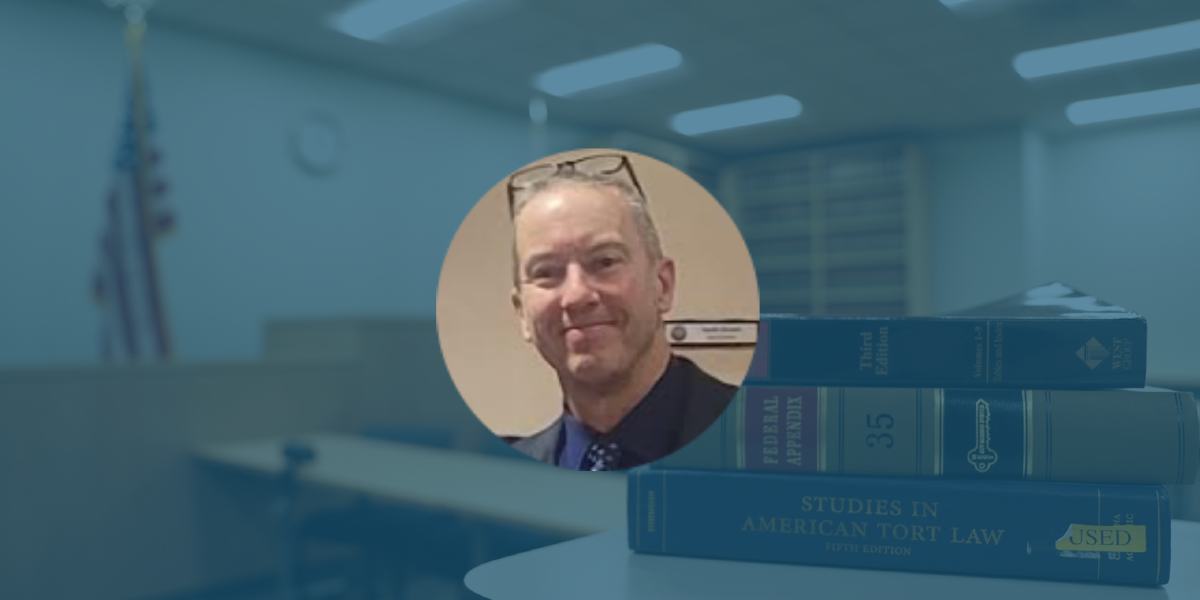
Faculty Spotlight: Douglas Reeve
 The Colleges of Law -
Mon, Mar 23, 2026
The Colleges of Law -
Mon, Mar 23, 2026
Douglas Reeve blends teaching and law, guiding students to build strong foundations and see their future in the legal profession.
BY ISABEL NELSON
Douglas Reeve, an instructor at The Colleges of Law, describes himself as a “full-time teacher, part-time attorney.” Yet if anyone had suggested that career path to him upon his graduation from high school, he wouldn’t have believed them.
After high school and several years in the U.S. Army, Reeve “went through the motions” for a while. “I didn’t really have a passion,” he says. “I thought you just get a diploma, you get a job, you get the house, and there’s your life.” Yet even with an undergraduate degree in business and a job that paid the bills, Reeve still felt like something was missing.
Reeve explored what was really important to him, namely helping people and feeling like he was making a difference. Despite having previously resisted the idea of teaching, Reeve couldn’t help but see how it aligned with his personal goals.
Reeve went back to school part time. He earned a teaching credential for middle school, and teaching middle school is a job he still holds proudly. But 10 years into his career in public education, Reeve watched as the teachers around him began to experience burnout. He didn’t want to reach that point himself. He felt that “if you have choices, then you never feel painted into a corner.”
Then a friend graduated from law school and passed the bar. “My friend’s achievement was, to me, just amazing,” Reeve says. “I thought, ‘I want that.’” Ready to dedicate himself to studying law, Reeve applied to The Colleges of Law.
After graduating from law school and passing the bar exam, Reeve continued to teach middle school but kept his legal skills sharp volunteering with California Rural Legal Assistance and the Public Defender’s office. He assisted agricultural workers to prepare wage claims and represented both juveniles and adults in criminal court. In both fields, he helped some of his former middle school students navigate the legal process.
The intersection of law and education continues to be a passion in Reeve’s life, and he hopes to focus on education and juvenile matters in his law practice when he retires from teaching.
Reeve’s time with The Colleges of Law started when he was a student, but it has taken several shapes before evolving into his current position. Initially, he was brought on to lighten the load for other instructors, grading writing assignments when not leading the middle school mock trial team. But his teaching talents were soon called upon for the 3L Advanced Legal Writing course as well as the 1L Legal Analysis and Writing course. Eventually, he was tasked with teaching Introduction to Legal Studies for the students starting in the spring semester.
Having been a spring start student himself, Reeve was eager to help students who couldn’t wait to start the next portion of their lives. “I enjoy playing a small role as students begin their study of law,” he says. “I want them to build a strong foundation from which they can have confidence as they move forward with their legal studies and beyond.”
Foundational Legal Skills is his favorite class yet to teach. Whether students are there to begin their path to a Juris Doctor or they intend to earn their master’s degree in Business, Law, and Technology, Reeve sees how important foundational classes are in higher education.
“The ‘light bulb’ moment that I enjoy is when students make a connection between what they are learning and the world around them,” Reeve says. “It’s typically in moments like this that students can truly visualize a place for themselves within the legal world.” Reeve believes The Colleges of Law is a place where “anyone with the dream of studying law has access to make their dreams come true.”