
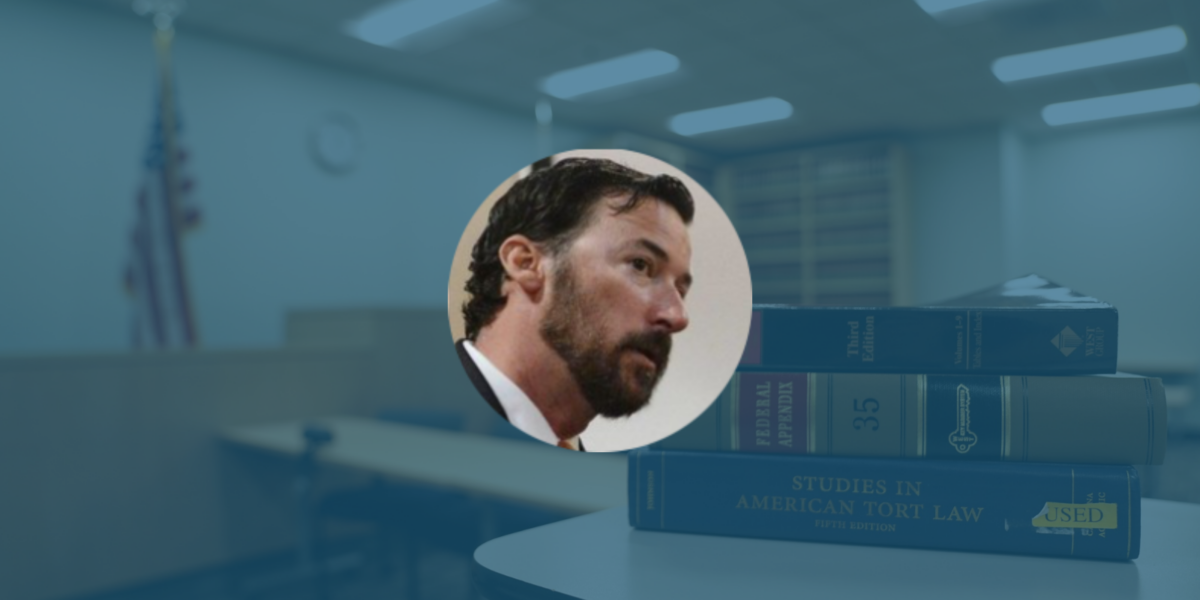
Faculty Spotlight: Justin Tuttle
 The Colleges of Law -
Wed, Dec 17, 2025
The Colleges of Law -
Wed, Dec 17, 2025
Adjunct professor Justin Tuttle honors his family’s legal roots but redefines what that legacy means.
BY REBECCA KOCH
For most families, a fifth generation following in the same profession would feel predetermined. For professor Justin Tuttle, J.D., it was his own calling, one he found on his own terms.
Growing up in Fresno, California, Tuttle started his career as a public defender in Tulare County. More than 27 years later and now a senior deputy public defender in Ventura County, he remains as committed as ever.
“As someone who was bullied and had a hard time as a child, being a lawyer is very empowering,” Tuttle says. “You get to stand up for yourself and your family members in different situations that come up in life, little and large ways those skills and that background can make a difference.”
Legacy isn’t about reputation or rank to Tuttle; it’s about using the law to stand beside others. As an adjunct professor at The Colleges of Law, he’s helping a new generation of lawyers discover that same purpose.
“I’m a fifth-generation lawyer,” Tuttle explains. “My grandfather worked in the rural community of Reedley, California, and was a city attorney for Orange Cove. He also briefly did criminal defense, representing migrant farm workers, and was instrumental in inspiring me to go into criminal defense.”
While his grandfather’s work and passion inspired Tuttle, it was also his own childhood and life experiences that shaped his career path.
“When I was in elementary school, my family went through severe financial issues,” Tuttle says. “Our home was foreclosed and we moved onto National Forest Service land in a small cabin, where we technically weren’t supposed to live full time.”
Tuttle adds, “When I had the opportunity to become a public defender, it stood out to me because I could stand up and be in court for someone who was poor, someone who didn’t have money and might be bullied by the system if they didn’t have a lawyer by their side.”
With close family members who suffer from severe mental illness, Tuttle’s work in the mental health unit allows him to make an impact in an area where he once felt powerless. He frequently goes to state and local county psychiatric hospitals, working with clients facing extension hearings for mental health holds.
Tuttle was drawn to The Colleges of Law because of the students’ drive to excel and finally go after their dreams.
He says, “One of the things I find most meaningful about The Colleges of Law is that our students often say, ‘I always wanted to be a lawyer, but life got in the way. I had to take a job or raise a family, but it was always in the back of my mind.’ I love those stories because I get to help them finally achieve that goal.”
Tuttle adds that the community at The Colleges of Law is unlike anywhere he’s studied or worked. “It’s supportive between the students themselves, which was not my experience at the law school I attended,” he says.
Tuttle notes that many adjunct professors, including himself, are also practicing attorneys. While having practicing adjuncts creates more interaction on campus through clinics, guest speakers, and other touchpoints with the legal community, it also helps students know what internships are available and who is hiring.
“We have our finger on the pulse when it comes to employment,” Tuttle says. “One of the important things law schools can do is help students find employment. The last time I heard from my law school was when I got my diploma. Nobody helped me find a job.”
Tuttle’s legal practice grounds his teaching. After nearly three decades in public defense, teaching gives him something new to look forward to and inspires his work. He wants his students to feel that same sense of purpose.
“Even if students aren’t interested in criminal procedure, they can still find Fourth Amendment search and seizure law and defending the Constitution fascinating,” Tuttle says. “My biggest hope is to convey that law can be fun and interesting. Being a lawyer is very empowering.”