
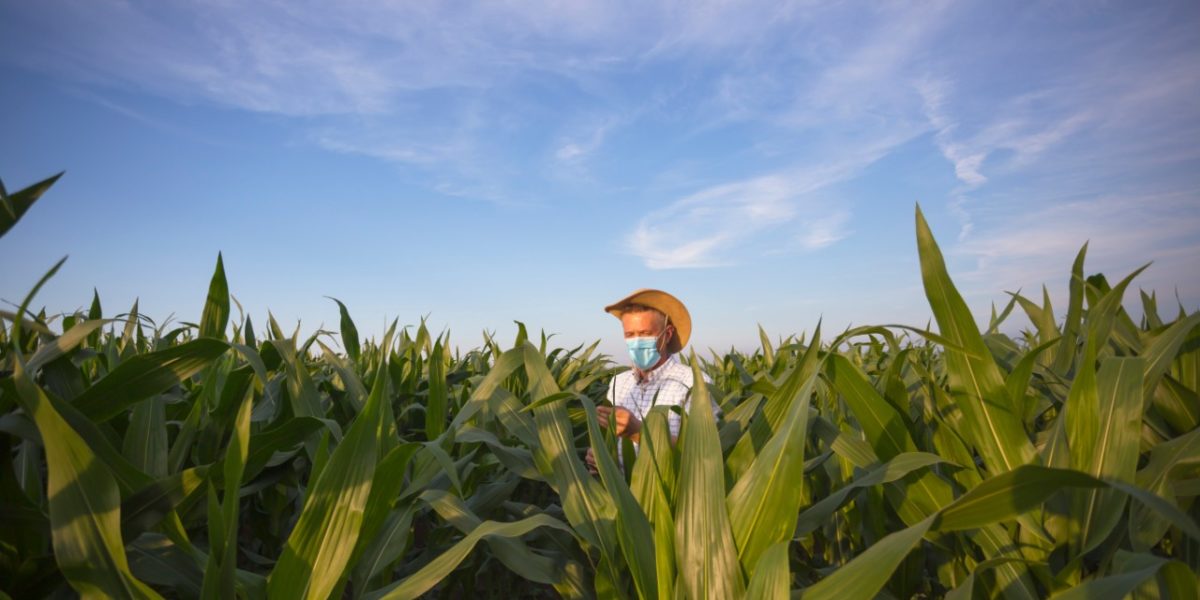
Farmworkers put their lives at risk during COVID-19
 The Colleges of Law -
Wed, Aug 19, 2020
The Colleges of Law -
Wed, Aug 19, 2020
Many essential workers maintaining our food supply are not adequately supported or protected by pandemic relief measures.
While many Americans have the ability to comply with stay-at-home orders at large, farmworkers do not have that luxury. They continue to work in the fields amid the pandemic. Farmworkers have been deemed essential to the sustenance of our country and thus remain in the fields. After all “you can’t pick strawberries over Zoom.”
Ironically, the nation’s essential workers are also some of the most vulnerable in our society. Carmelita, a sole provider for her children and a farmworker from Oxnard, California, when asked about her thoughts working during the pandemic, stated, “You’re trying not to get exposed, but unfortunately we don’t have the ability to stop working. The state calls us essential workers, but they’re not demonstrating our value. We’re putting ourselves at risk to feed the country.” Carmelita is not wrong to worry—social distancing is difficult to do in her job.
Issues with H-2A housing
Living conditions present a grave threat that risks the health and safety of farmworkers. On July 7, a total of 204 out of 216 people tested positive at the Villas Las Brisas housing facility in Oxnard. Villas Las Brisas is a dorm-style facility that houses up to five temporary migrant farmworkers in one room through the H-2A visa program. Some farms have rebuilt housing for workers to cure the problem of cramped sleeping quarters; however, these efforts are few and far between around the country.
Farmers who employ H-2A workers must provide housing. The H-2A program allows employers to bring in foreign nationals to fill in temporary agricultural jobs. It is estimated that H-2A workers comprise 10% of the farming workforce. The H-2A employees live in cramped quarters and carpool to work, meaning COVID-19 could spread like wildfire among the farmworker community if proper social distancing precautions are not taken.
Recently, the H-2A provisions have been amended to allow all H-2A petitioners with a valid temporary labor certification to start employing foreign workers who are currently in the United States and in valid H-2A status immediately after United States Citizenship and Immigration Services (USCIS) receives the H-2A petition. In the past, the prospective workers needed to apply for the H-2A program outside of the United States.
The USCIS is also temporarily amending its regulations to allow H-2A workers to stay beyond the three-year maximum allowable period of stay in the United States. These changes are temporary and meant to facilitate the employment of farmworkers during COVID-19.
However, no changes have been made regarding policies regulating housing for H-2A workers. This presents an even larger complication when considering what would happen if an H-2A worker needed to quarantine while living in cramped housing with multiple roommates.
In an updated notice, the Centers for Disease Control (CDC) failed to provide adequate safety guidelines for immigrant farmworker housing when a person required quarantine. Instead the CDC only recommends separating workers who have symptoms when feasible.
Employers not giving workers notice
Another issue that has brought fear to many workers is the lack of adequate notice from management concerning positive COVID-19 cases. Since June 10, 2020, 31 workers at Primex farms, 150 miles north of Los Angeles, tested positive for COVID-19. On June 25, 2020, a group of about 50 farmworkers went on strike, demanding free face coverings, gloves, and information from the Primex owner as well as demanding that they be informed when workers tested positive. Had it not been for the news coverage, these workers would not have known that many of their co-workers had tested positive for the virus because their employer failed to keep them informed.
An article published by The Fern recounted the story of Rosa, an undocumented Mixteco mother of three, who works in the fields picking strawberries. She stated that she had heard that some workers had tested positive but that the foreman had told her to “keep quiet.” Rosa stated that she and her co-workers had received no information from the company regarding positive COVID-19 cases. Further, she stated that the company followed social distancing rules in the beginning of the coronavirus pandemic, but it was no longer enforced and workers continued to work closely together.
Payment poses another issue that exacerbates the health of farmworkers
How farmworkers are paid further exacerbates the issue. Many farmworkers, especially during peak season, are paid by quantity. For the last few years, Driscolls, one of the world’s largest berry distributors, has been under fire for not paying farmworkers livable wages. Strawberry pickers are paid by the amount they pick. In June 2020, after boycotting Driscolls, farmworkers won a raise to $2.10 from the $1.90 per box of strawberries. This came after Laguna Farms demanded farmworkers pick the biggest strawberries without raising their pay, which would take farmworkers longer to fill a box for less pay.
Arguably, this system of payment incentivizes farmworkers to skip their breaks for water and rest or to wash their hands. For many, they are risking their lives because they are the only viable source of income for their families.
The struggle for farmworkers’ rights is ongoing
For farmworkers, the struggle for their rights as workers is ongoing. While the 1938 Fair Labor Standards Act guaranteed most workers the right to a minimum wage, farmworkers didn’t gain the right to fair pay until 1966 and didn’t gain the right of overtime time pay in California until 2019. That right may be taken away for H-2A workers if the Trump administration’s proposed rule changes come into effect, which could result in wage cuts for these workers.
The CARES Act and farmworkers
In response to the COVID-19 pandemic, the federal government signed the CARES Act into law. An estimated $23.5 billion was allotted to help the agricultural sector but no mention was made as to whether a portion of that money would be allocated to farmworkers’ health or any provisions for mobile clinics and other crucial programs for migrant workers.
The CARES Act also provided individuals who make less than $75,000 with a rebate check of $1,200. To qualify, an individual must have filed a tax return during the past two years and have a social security number. According to the National Agricultural Workers Survey, the average income for a farmworker is $15,000 to $17,499 a year. This figure is way below the $75,000 a year cap to receive a stimulus check; however, it is estimated that half of the farmworker population did not receive one because they are undocumented.
Additionally, the CARES Act does not provide relief for undocumented workers, even if they do file a tax return with an Individual Taxpayer Identification Number, if left unemployed or contract COVID-19. Although many undocumented workers do in fact pay federal taxes, they are not able to access federal aid. The CARES Act proved to be no different.
California became the first state to offer $75 million to support undocumented workers who are affected by COVID-19 and mandating that those employed in the food sector, such as farmworkers, receive an additional two weeks of COVID-19 paid sick leave, regardless of immigration status. Other states have yet to join California in allocating a relief fund for their undocumented populations.
With Congress unable to decide on another stimulus package, it is not clear whether the HEROES Act or the HEALS Act will be allocating any aid to farmworkers.
The dichotomy of the situation cannot be denied. While farmworkers are among the country’s most essential workers, they are also among the most vulnerable. It is estimated that a quarter of the H-2A workers California hires work in the Santa Barbara, Ventura, and San Luis Obispo County areas. The issues surrounding farmworkers are complex, and this pandemic may be the phenomenon that unravels them.
ABOUT THE AUTHOR
Elizabeth Muñoz is a first-generation Mexican- American second-year law student at The Santa Barbara & Ventura Colleges of Law. Prior to enrolling at the Colleges of Law, she earned a bachelor’s degree in History of Public Policy, exploring the labor relationship between Mexico and the United States, from the University of California, Santa Barbara.
Learn more about The Colleges of Law
Fill out the form below to request more information about our J.D., Hybrid J.D., and online Master of Arts in Law programs.